Friday, July 15, 2011

Off the boat

With New Morning safely tied up at Taina Marina we've been off the boat a little more time than we originally planned.

Tight on space, the marina put us on the outer wall, med moor style, with the mega yachts. Flattering, but not such a good spot when the 4+ meter waves started breaking on the reef. New Morning was really bouncing around so we decided it was time to take a break and move to the Radisson on the other side of Papeete for three days. It was excellent. It was nice to be off the boat with long showers, a big bed, lots of internet, somebody else doing all the cooking and no thoughts about the weather or the anchorage. We took the shuttle into Papeete and got our carte de sejours, bought some gifts and relaxed.

Then we learned that a good friend of Fay's was in Moorea for a month. So we were back on the boat for two nights, then off to Moorea for the weekend. A great stay in the house you see in the picture and a chance to tour Moorea by car as well and enjoy some excellent snorkeling. The back to New Morning for two more nights and time to celebrate Fay's birthday!

I had long ago made a reservation at the Intercontinental to celebrate her birthday so we've been here for the last three days. We had expected lots of celebration activities as Fay's birthday is July 14 which is Bastille Day in France and pretty analogous to the Fourth of July. But apparently the French Polynesian's relationship with France is a little strained. It was a natinal holiday, but there were no parades or fireworks. So we had our own champagne and celebration!

Tomorrow we leave the hotel and then on Sunday we'll move to Moorea, this time on New Morning.

Sunday, July 3, 2011

Tahiti

The picture is of Moorea from Tahiti. It felt like the volcano was erupting.

Our passage to Tahiti was mostly uneventful. We hated to leave Rangiroa with such beautiful weather, but the forecast of winds and big swells was undeniable. We had some sailing wind the first few hours and got a nice ride from the spinnaker for 3-4 hours, but when the wind dropped and we were making only 4kts it was time to start up the engine and make some miles while the seas were still calm. We arrived in Tahiti on Friday afternoon.

Geographically, the Society Islands (Tahiti, Moorea, Bora Bora, etc.) are sort of the sum of the Marquesas and the Tuamotus. The Marquesas rise to 3,000' directly from the ocean. The Tuamotus are atolls, the remnant of a volcano and a few thousand years of coral growrth, barely 10' above the water and only a few hundred yards wide. The Societies are like putting an island from the Marquesas into the lagoon of one of the atolls. The result are islands that rise dramatically from the ocean, but are surrounded by a fringing reef which leaves a navigable ring of water around the island, almost (more on that in a minute) entirely protected from the ocean swells.

We received permission to enter Papeete harbor through the pass (apparently quite busy), then after a plane landed, we received permission to transit around the airport to the west side of the island. The airport is right on the water and we motored past both ends of the runway. It seemed like every boat we'd met in French Polynesia was in the anchorages, and another 50 that we didn't know. The marina informed us that they had no berth for us, but fortunately Fay spotted an empty mooring ball (snag now, ask questions later) and had a line through it on our first approach. We were soon visited by Francois from the Association of Sailboats in Polynesia who advised us that 1) the owner of the mooring could return at any time and 2) there would be unusually strong winds on Sunday and we should be sure to stay on our boat.

Saturday the marina offered us a berth with the caveat that it would not be comfortable, but we figured it could be no worse than the bouncing anchorage. The waves breaking on the reef were quite impressive and some of the energy spilled into the lagoon to join the wakes from all the power boats blasting back and forth in front of the marina to make very bouncy water. Our berth was a med mooring space on the outside row facing the ocean (normally reserved for mega yachts) and we heaved up and down pretty dramatically until about 4am on Sunday morning.

Today has been much more calm as the waves have dropped in size per the forecast and there were a lot fewer power boats and jet skis. The forecasted 20kt winds have either not materialized, or we're protected here on the west side of the island. But the seas are forecast to rise again over the next few days, this time to 15' with 23kt winds.

Our outside berth is not going to offer any protection so we're going to make sure New Morning is secured, and then make a strategic retreat to a hotel. Yes, we're moving off the water for three days! Time for a break from our sailing adventure, and an opportunity to do some clothes shopping in Papeete. Cruiser attire of shorts and a t-shirt is pretty basic and not quite appropriate in the "big city". We're going to be in the Society Islands for a few months so it's time to upgrade our appearance a bit. We also need to make a visit to the High Commissioners office to obtain our long stay visa and have a few other errands we need to do in town. We'll be back.

Wednesday, June 29, 2011

Catching up

We've been busy and I'm behind.

We spent four pleasant and busy days Toau. Several other boats that we knew from previous anchorages converged on Toau resulting in a hectic social calendar with cocktails and/or dinners every night on one boat or another.

The highlight was definitely a dinner ashore with Gaston and Valentine. Gaston and Valentine offer a dinner three or four nights a week for 3,000 XFP, about $35, and BYOB. The dinner far exceeded expectations and included seemingly unlimited lobster and poisson cru (French ceviche), complimented with fresh coconut bread and a number of side dishes all finished off with a delightful coconut cake. Then the fun began. Gaston seemed to have unlimited energy to match Valentine's unlimited laughter, so after dinner the dancing began and they had the moves! Soon everyone had joined in and we danced the night away, well past cruiser's midnight (9pm).

Toau also had some nice snorkeling. One of things we hadn't see up close before was a fish trap and Gaston had several. A fish trap is sort of a maze that fish swim into and get trapped. It looked to be built of a wire mesh on metal poles driven into the bottom in 10' - 15' of water. Gaston's fish traps had a huge variety of fish, I think half the fish that inhabited the entire area were in his traps! There was everything from schools of small reef fish to a huge moray eel, massive Napoleon wrasses, a spotted ray and several sharks ranging up to 6'. We snorkeled around outside peering into it like an aquarium while the fish swam around trying to figure out how to escape. One shark was quite agitated and seemed to be trying to figure out if he could leap over the fence (probably not).

As we've seen elsewhere in French Polynesia there were plenty of sharks outside the fish trap as well. It's pretty much impossible to go in the water and not see sharks. Sometimes this bothers me more than others. We snorkeled around Anse Amyot and there was almost always a shark or two within sight, and certainly more than we couldn't (being lowly humans with weak sensory systems). There were also a wide variety of reef fish to keep Fay's camera busy and not as much current as in Fakarava so it was a little more relaxing. But when we returned to the boat and I was scrubbing the waterline I saw two of the largest sharks I had seen yet circling below the boat. Enough for one day, I forgot the grass on the waterline and got out of the water.

We departed Toau on Sunday night and sailed overnight to Rangiroa. We arrived at the Tiputa pass a little after what was supposed to be slack current and still had about 3kts of ebb current against us, but fortunately no large standing waves. Just as we almost committed to entering the pass the engine began sputtering. A quick look at the panel showed the vacuum gauge was almost maxed out; the dirty fuel we had purchased in the Galapagos was still causing problems. I spun New Morning around and headed back out to sea while Fay flipped the valve on the fuel filters. With a clean filter the engine was soon settled down and we were able to transit the pass without further drama.

We really didn't sleep on the passage to Rangiroa so after we were anchored (or more accurately just hooked on some coral) we collapsed on the bed and slept for four hours. Within twenty minutes of rousing ourselves from our mid-day sleep we were invited to a cocktail party! Cruisers from Jersey (the channel islands, not the state), Australia, Canada and the UK, including two dive masters. We drank, chatted and faded early, taking a rain check on dinner.

Yesterday morning we re-anchored, getting the anchor into a nice patch of sand, then floating our chain above the coral so that it didn't get fouled and also didn't keep us up at night as it dragged across the coral. Fay went pearl shopping one more time, then we joined four other cruisers for a dive in the pass. The dive was a bit more challenging than we would have preferred, but also rewarding.

We went out the pass in a large inflatable boat and then turned right and ran down the atoll some distance. The waves were only about 4' - 6', but large enough to toss around the big inflatable and all of us within it. We struggled a bit to get into all of our dive gear, then all flipped backwards off the inflatable on the count of 3. Into the water and down we went to about 50'. The reef wall was almost vertical and dropped off to several thousand feet so stopping at 50' was somewhat arbitrary. We swam along the wall while the dive master ventured out "into the blue" in search of dolphins. Soon several dolphins appeared and we swam out towards them, but they didn't stay too long and didn't seem that interested in us. We see dolphins all the time from New Morning, but it was quite different to be in the water with them. These were bottle nose dolphins and they are quite large, well over 6' and very fast. Magnificent to see them under water in the wild.

We swam back to the wall and continued towards the pass, exploring the wall as we went. Once we got close to the pass the current picked up and we were swept into the lagoon with the current. As in Fakarava the bottom of the pass was thick with sharks, but this time they were below us and we didn't swim right through them. Not a relaxing dive, but certainly memorable.

Today was more relaxed. We checked the weather this morning (the outlook is poor), then Fay and I took our dinghy out to a small motu (aka island) just inside the pass and dove in 30' - 40'. Although as soon as we reached the bottom we were greeted by a large moray eel flexing his jaws for us, the dive was generally quite relaxing dive with lots of reef fish and one very large barracuda, as we swam through an assortment of canyons between massive coral formations.

Back on New Morning we did some boat chores and started packing up. We had planned to stay here for a week, but the weather is not going to cooperate. A very large high pressure area to the south is going to create some strong winds by Sunday (25kt - 30kt), pushing 10' - 12' waves into the area by Saturday. The atolls only provide protection from the normal trade winds, a wind shift of just 30 degrees can turn a quiet anchorage into a lee shore with large waves. Worse yet, the passes can be essentially closed as the winds push water into the lagoon which then flows out the passes continually, creating large standing waves which are quite hazardous to attempt to traverse. At that point we would just be trapped in the lagoon getting pounded by big waves. As one cruiser wrote, it's "no fun atoll".

Despite the fact that we're now enjoying the calmest weather we've seen in two weeks (we've had a steady supply of squalls day and night), we need to bail out tomorrow and complete the 200 mile passage to Papeete before the waves arrive on Saturday and the big winds shortly thereafter. Ironically we'll probably have to motor much of the trip because this is the proverbial "calm before the storm". The marina has advised me that they won't necessary have room for us when we arrive since our reservation was not until July 7th. So we plan to be behind the reef in Papeete by mid-day on Friday, but were not sure exactly where!

Thursday, June 23, 2011

More Fakarava

After four days of unusually calm and pleasant weather the wind and squalls returned so it was time to depart the south end of Fakarava. Since everything is closed on Sundays we decided to motor about half way up the east shore and spend the night in a small anchorage with some friends. On Monday we returned to Rotoava at the north end and did a little grocery shopping.

Tuesday was a busy day. It started with some friends delivering Fay's order from the boulangerie, more croissants, pain de chocolat and baguettes. Next was a tour of the Dream Pearls pearl farm about 10km south of Rotoava. Lu-lu picked us up at 8:30 and drove us to his farm. Farming pearls is a much more elaborate process than I had imagined.

Lu-lu buys one year old oysters from another farm elsewhere in the Tuamotus. To initiate the process they drive a small wedge into the oyster to open the shell and allow the oyster to "relax" a bit into the slightly opened position. Then one of several Chinese technicians who commute between China and the Tuamotus inserts a nucleus into the oyster. This work is all done with what appears to be surgical quality stainless steel instruments. The nucleus is a piece of oyster shell from Mississippi that has been machined into a sphere in sizes ranging from 4mm to as much as 16mm. Additionally they insert a 1mm square piece of shell in the color that they would like the oyster to build onto the nucleus. It's not clear to me why the oyster mimics that color, but that is apparently how it works. Then they close it up, drill a hole in the shell and tie them to a sort of tubular net that protects the oysters from predators. They hang the nets in the lagoon and leave them for about two years.

To harvest the pearls they haul the nets ashore, cut the oysters loose and again insert a small wedge into the shell. The Chinese technicians then remove the pearl and insert another nucleus slightly larger than the previous nucelus. One oyster ends up producing 2-3 pearls before they scrap the oyster; the meat is eaten and the shells are shipped to Asia to be made into buttons (aka "mother of pearl").

If all goes well, the oyster has built a perfect layer of nacre around the nucleus, about 1mm thick. In practice not all the pearls are round, and they have varying numbers of imperfections, apparently at least in part a function of cleanliness of the nucleus and insertion process. The pearls are classified by shape, luster, size and color, then sold in bulk primarily to Japanese firms which distribute them world wide. The farm that we visited produces about 80,000 pearls / year.

There is of course a showroom at the farm and with Fay's birthday just a few weeks away she had an enjoyable time picking out her present!

Later on Tuesday we raised anchor (another story for another time), moved about five miles south and anchored in front of the White Sands Hotel so that we could have dinner there that evening. It was worth the trouble. It was the first upscale restaurant meal we had had since early March in Panama and it was excellent. We pooled our orders and had risotto, parrot fish, a nice New Zealand steak with mushrooms, and several glasses of decent chardonnay and merlot, all capped off by creme brulé and swiss chocolate truffle cake.

Wednesday was moving day so we were up at 6am to be at the pass by 8am for slack current. All went well and we had a pleasant sail to Anse Amyot on Toau. Anse Amyot is not really a pass, more like a cove protected by a very shallow reef from the main lagoon. The one family that lives here has put down moorings so we're on a mooring for the first time since Bonaire. It's nice not hearing our chain scraping across coral and with so little fetch even when it blows 20-30kts for a couple of hours as it did earlier today the chop is small so New Morning is not tossing around.

The report from some other boats that went diving this morning was not great so we've canceled the dive plans and this afternoon we'll go snorkeling right off the boat.

Friday, June 17, 2011

Fakarava South - In the Brochure!

We've been here since Tuesday but it seems like much longer. So much going on in so little time.

Fakarava atoll encircles a body of water roughly the size of Lake Tahoe. The water is generally 50' - 100' deep, but with enough coral heads and pearl farms that it's important to either stay in the marked passages or keep a very sharp lookout. We motored to the south end on Tuesday, following the excellent of markers. Then we followed some waypoints from another cruiser through a tricky section that brought us to our current anchorage (see Where's New Morning - select the satellite picture and zoom way in) where were joined a couple of other boats that we knew from past anchorages, and have since been joined by another half dozen boats over the last two days.

The wind died off almost entirely as soon as we arrived so it's been absolutely flat calm. A little breeze today and the trades are expected to return tomorrow. We're in about 18' of sparklingly clear water and we can clearly see the bottom, the black tip sharks swimming around the boat and our anchor chain snaking around large coral heads.

The first night here was a BBQ on the beach which was spectacular. A full moon rose over the little island and reflected off the flat calm lagoon, perfect air temperature, no bugs, a bonfire on the beach and a great group of people. Canadians, South Africans, South Africans that emigrated to Canada, Americans that emigrated to Canada, French, French Canadians and even a family from Tiburon, just a few miles from our home in Sausalito. And we've since been joined by another boat from California as well as more friends from Canada. And two boats each with a few teenagers mixes up the group even more.

Back in Nuku Hiva Fay had seen a number of black tipped sharks in the shallows of Anaho Bay. Here they are ubiquitous! Yesterday we went snorkeling along the east side of the pass in amazingly clear water with fantastic reef fish, huge amounts of healthy coral, many large groupers, and a good collection of sharks. We snorkeled on the incoming tide which carried us right into the little "resort" just inside the pass and the only commercial thing here at the south end. In the shallows (< 3') around the docks and shore buildings there were more sharks, as well as a huge emperor fish (aka Napoleon Bonaparte fish) and a nice collection of reef fish. Crystal clear water and lush coral, an incredibly beautiful and entirely natural location.

Two nights ago was was more socializing when some friends paddled up in their inflatable kayaks and then stayed four hours for "dinner", drinks and a few beers.

The hotel is completely booked so they won't sell us a drink, dinner or any dive trips. With no professional divemaster available, yesterday we put together our own dive trip. We ended up with eight people in three dinghies. It was quite a production getting all the gear together and traveling around the reef to get to the south pass (a good 20 - 25 minute dinghy ride). We dove to about 80', then came up the pass with the incoming tide. We didn't time it very well so we had a lot of current which shortened our dive, but it was still spectacular.

Sharks! Hundreds of sharks. Black tip (good), white tip (not so good) and gray (definitely not good). First I saw maybe 10-15 and thought that was impressive, certainly more than I had ever swam with before. Then I saw a group of maybe 30-40 sharks that were deeper than us and that upped the ante. The current was picking up so it was kind of like being on the moving sidewalk that they have in some large aquariums to keep the people moving past the fish. Then right at eye level I saw a school of over a hundred sharks which momentarily startled me. At this point we were being carried in with the current and didn't have that much control over our position; it was clear we were going to be taken right into the school of sharks. Generously, most of them lazily swam away, but a few were more curious and lingered to have a look at us, and one swam straight at me. We stared down and then he turned away. That's not necessarily good because they like to attack from behind anyway.

Last night was another dinner and bonfire on the beach. This time there were people from eight different boats! And we knew the people on four of these boats from past islands and anchorages, some as far back as Panama. We got rained on pretty good for about 25 minutes, longer than the usual squall because there was so little wind to move it along. But we dried out, built up the two fires and everyone was fine. Fay had a small mountain of tuna on the BBQ and a home made olive tapenade.

Sometimes we go for a couple weeks without much socializing, then we're surrounded with people, all pretty much unorganized and just the chance that we're at the same anchorage at the same time. Back in the Marquesas Fay wanted to keep touch with a couple of women on other boats so she set up a time to chat with them on the radio. Within a couple of weeks it had turned into a "net" and lots of boats were calling in from all over, a couple of people took over as net controllers and out of nowhere a morning cruisers net had been created. There are a few other nets, all passed along by word of mouth to share passage, anchorage and weather information, as well as just keep each other informed about their current location and travel plans.

The time here in Fakarava south has been great, in part because the weather was so perfect. But the weather is beginning to change so we'll probably move on tomorrow. The rough plan is to return to the north end of Fakarava, via an overnight stop at the south east corner behind a small motu. Then we'll head to Toau. Next on the agenda is Rangiroa and Tikehau which are more developed, but supposed to have great diving with professional dive companies. We still plan to be in Tahiti for Bastille Day and Fay's birthday.

Saturday, June 11, 2011

Fakarava

The passage to get here was unusual. We expected a pretty simple 550 mile passage, about three days. It turned out to be a little more complicated. We had more favorable current than expected which resulted in a 209 mile first day and faster speed throughout the passage, none of which was in my assumptions about passage time and arrival time at the pass at Fakarava. We made the unusual decision to heave to for seven hours in the middle of the trip, something normally reserved for very bad weather, to delay our arrival. Then on the final morning into Fakarava we had 25-30kts of wind, way more than we needed. We triple reefed the main and furled the jib to slow us down, again trying to arrive at the appointed hour.

We arrived a little early, but the pass was wide (500yds) and deep (30') which made it easier. In the end we were two hours early and had a 3kt flood current pushing us through the pass and into some small standing waves in the lagoon. We punched through those waves and then motored the five miles back into the wind to Rotoava. We anchored and sighed with relief. After subtracting out the seven hours when we were hove to (and actually going back towards the Marquesas for part of it), we had an average speed of 8.7kts for the passage, which yields an average day of 209 miles (surprise!). Way faster than the 175 miles / day I had assumed. Even discounting for the 1kt of current, we still averaged over 7.7kts or 185 miles / day. I'm going to have to update my passage assumptions.

We were exhausted when we were finally settled around mid-day. A couple of beers led quickly to an afternoon nap. Then last evening we watched a movie and as we got into bed around 10:45pm we heard a car horn (we thought) and then noticed a really bright light. We got out of bed and went into the cockpit to see a ship bearing down on us. It was at least 250' - 300', a good sized inter-island cargo vessel. This was 11pm on a Friday night so a bit unusual. The captain decided he would drive his ship between New Morning and the French flagged 45' Beneteau anchored next to us about 50yds away (measured while anchoring). The ship could not have had more than 30' - 40' of room on either side between his ship and our little boats. From our side it was just a wall of steel moving by with a French guy shouting something at us and waving his arms. Had I been more on my toes I would have responded with some fitting hand gestures and words of my own, but I was too in shock.

Both of the small boats normally "sail" at anchor, swinging back and forth in a pretty wide arc as the wind blows the bow first one way and then the other. Had we swung towards each other (as frequently happens since we don't swing in sync) when the ship was coming between us, this would have been a tragedy instead of a story. If we were really blocking the dock (and two other ships came in today and had no problem going around the fleet of anchored yachts), the captain could have sent a small boat to tell us to move, or had the gendarmes come out and fine us. Instead this guy just decided to drive his ship through the anchorage. It's only luck that he didn't hit one of the boats or suck up an anchor chain into his screw.

And to cap it off, the ship was at the dock for no more than 15 minutes and then sailed off into the night. Apparently he was just dropping someone off or picking someone up, not actually transferring any cargo. I later spoke with the owner of the Beneteau and he had the same reaction (though in French). The captain was simply being reckless late on a Friday night. Since neither boat was hit, or no anchor chains snagged, it's now a good story instead of a tragedy.

We're currently anchored with about a dozen other boats in the lee of the village of Rotoava in the NE corner of Fakarava. The geography is a bit odd, sort of 60 miles long x 300yds wide, wrapped roughly in the shape of rectangle that is 10 miles x 20 miles. There is clearly some good infrastructure with a nice concrete road through town, cell phone service, an airport and street lights through the village which look lovely from the boat at night.

We took the dinghy in for a look around and found a really nice village. The market was well stocked (though no cheese), the boulangerie had fresh croissants (the French know how to use butter), the homes were neat and nicely landscaped and the residents friendly.

The produce prices were a bit shocking with a tomato selling for $7.50, an avocado $8.50 and a head of lettuce $14. That would make a very expensive salad! But we did buy some nice pears from the US and promptly forgot the price as we enjoyed the fruit.

Tomorrow is Sunday so everything is closed up tight. On Monday we'll go back and rent some bikes so that we can explore more of the atoll to either side of the town. We had hoped to do some diving here, but we've learned it's very advanced diving that starts with a rapid decent to 100' to avoid the strong currents. Not our style of diving. Next week we'll sail to the other end where there is rumored to be some good diving and snorkeling, with possible overnight stops at other anchorages along the way.

Friday, June 10, 2011

Whew!

We're anchored off Rotoava in the north east corner of Fakarava. More later.

Wednesday, June 8, 2011

Too fast

In our first day on passage from the Marquesas we did 209 miles. Normally we'd be rejoicing, but today it's a problem.

Timing arrivals is always a bit tricky. Out of a 24hr day there is normally an 8-10hr window for arrival when we'll have good daylight and visibility. Arriving an atoll narrows that dramatically. The atolls are sort of ring islands, with one or two cuts or passes in the ring through which we enter the lagoon. The lagoons inside the ring are quite large, I think Fakarava is about 10 miles x 20 miles. The issue is that the tide waters from the entire lagoon flows in/out of these narrow passes creating very strong currents. Transiting the pass should normally be done at slack tide when the current will be minimized. That means our arrival window is reduced to maybe two, one hour slots each day.

Theoretically slack tide at the north pass of Fakarava will be about 10-11am on Friday morning. There is no published data on this, just some tools from another cruiser and some tide tables. It's not an exact science. Then it gets verified by arriving at the pass and looking at the conditions. No standing waves is a good start. After that it's pretty much just go for it.

I timed our departure to arrive about 9am on Friday morning, but assumed 175 miles a day. With the winds on the beam, and current behind us, we've gone much faster; 209 miles our first day. If made no changes we'd be arriving in the middle of the night, maybe midnight on Thursday. Then what do we do? It's hard to slow the boat down. We can reduce sail, but it doesn't slow us that much, and in larger seas we need the power/speed to punch through the waves rather than be slapped around by them. So what's a navigator to do?

At the moment we are "parked", or more nautically we are "hove to". We tack New Morning into the wind, but don't release the jib. The jib is backed pushing us one way while the main is pushing the other way. The result is that we're sailing / drifting at about 2kts back towards the Marquesas. We'll do this for 6-7 hrs, then resume on towards Fakarava. If it all works out, we'll arrive in daylight of morning on Friday and then wait for the pass to be calm enough to enter the lagoon.

Monday, June 6, 2011

Tuamotus departure

We've been waiting to see how some weather in the Tuamotus and Tahiti would evolve before departing. The South Pacific is currently dominated by a big high which causes "reinforced trade winds" (a euphemism for stronger winds). And on the NE boundary there is an occluded front which brings rain. We've been trying to figure out when to depart so that we'll have reasonable passage weather, and reasonable weather upon our arrival. It looks like tomorrow is as good as it going to get for the forecastable future.

We're expecting to have moderate winds the first two days, then 20+ knots the last day, probably mixed in with squalls and rain. This doesn't sound that great, but it's better than departing a few days from now and having 20+ for our passage with 3 meter seas, and also better than departing a couple of days ago when we would have had very light air for the passage, then have been greeted by 25-30kts gusting to 40kts. We'll have the staysail ready on the foredeck and make sure everything is well secured below. Assuming we can get through the north pass on Fakarava we should be protected from the trade winds in the NE corner of the atoll.

In preparation for our passage, yesterday we "cut the grass". It's amazing how fast grass, or seaweed, grows along our waterline. We just cleaned it off three weeks ago, but it had grown back enough to need cleaning again to improve our sailing speed for the passage. We've moved out of suburbia, but we still need to cut the grass!

Today Fay went ashore to find a home for our garbage. We've gotten very good at not producing a lot of garbage by managing packaging as we bring things onto the boat. But some amount of packaging is still aboard and over time it accumulates. We now generate a bag of garbage about every 3-4 weeks, not bad compared to the 2-3 bags a week at home!

Time to pack up, stow the dinghy and have a last cocktail before our departure.

Saturday, June 4, 2011

Weather hold

Fay took this great picture of Anaho Bay this morning. New Morning is the boat on the left (if you can make out any boats at all) and we're currently sharing the bay with just one other boat. She also saw about a dozen juvenile (4' - 5') black tip sharks in the shallows (2' - 3') as she was walking from the dinghy to the beach. We were surprised they would be in such shallow water; maybe a picture of those later. She came back from her walk with a big bag of mangos.

The weather here is so nice we're going to stay a bit longer. Our study of the GRIBs (forecasted winds) suggests we'll get a little more wind for our passage, and a little less wind and rain on our arrival, by delaying our departure until Tuesday, so we think this will work out for better weather everywhere.

We're focused on atolls where we can dive with a dive master, and also looking for pearls so we're settled on making our landfall at the north pass of Fakarava (Google that!). After Fakarava we'll probably proceed on to Toau, Rangiroa and Tikehau, and we might add Manihi into the mix after Toau depending on our time. Apparently the Bastille Day festivities go on for weeks, so we're concerned that the week of the 11th might find a lot of government offices closed. With that in mind, we'd like to be in Papeete by July 6-7 to finish our customs processing for New Morning, and receive our long stay visas.

Thursday, June 2, 2011

Anaho

On Tuesday we motored from Taiohae on the south side of Nuku Hiva to Baie Anaho on the north side. The trip was a little longer than expected as we pounded into large seas for the first hours making our way east along the south side of the island. Then we turned up the east coast which was fairly foreboding with a pre-historic feeling landscape and no signs of humans. All the more so as the sun was getting a bit low and dusk is short in the little latitudes.

We unrolled some jib and stabilized the boat against the beam seas. After about ten minutes the wind went a little further aft and we unrolled more jib and actually picked up some speed. It took about an hour to travel around the east coast, then turn west and run down to Anaho. We dropped the anchor with the sun already over the hill and were having a beer with Rob and Thia on Changing Spots within 30 minutes.

The last two days have been boat chores and laundry. We still get rain here, but no as much as in Taiohae so Fay is able to get all the wash done (a month's worth!) and we do projects outside without being constantly wet. And the water is not muddied with run off so we can run the water maker. The scenery is spectacular.

Last night Fay organized a "floating cocktail party". Cruisers from four boats motored to the windward side of the bay, lashed the dinghies together and proceeded to share munchies, cocktails and stories as we drifted across the bay back towards the boats. When we had drifted all the way across, one of the dinghies dropped an anchor and we chatted until well after dark.

We're starting our detailed look at the Tuamotus, looking at the weather and figuring out where to make our landfall. The Tuamotus are a large collection of atolls, basically just the rim of a volcano sunk to sea level. They are very low and difficult to see until you are quite close, with strong currents between them, and in the passes that allow us in/out of the lagoons within. Quite a contrast to the towering mountains of the Marquesas.

A few more boat chores and a little more study, then we depart in 2-3 days.

Monday, May 30, 2011

Here comes the Sun

Today the sun came out, it didn't rain, the seas calmed a bit and the winds stopped blasting us from every direction. A big improvement.

We rented a car and drove to over the mountain behind the bay (about 3,000') to Hakahaa for the reception for the Pacific Voyagers (www.pacificvoyagers.org). There we saw all the boats and dancing / presentations by all the crews as well as the Marquesan hosts (a replay of the dancers we saw on Friday). Then we drove over the hill to Hatihieu to visit some archeological sites, then back to Taiohae. The country side is a spectacular display of lush green everywhere, and pretty vertical! We had good reason to have rented a 4WD vehicle for some of the roads. A full day time for sleep.

Saturday, May 28, 2011

A night and several days to forget

Changing islands didn't turn out to be quite so simple. What were we thinking?

We departed peaceful Tahutata at dawn. Actually since it was a 65mile trip we began before dawn as the sky was just getting light. We had plenty of wind for a couple of hours as we gybed back and forth to avoid the wind shadow of Hiva Oa, then the wind shut down completely and we motored for about two hours, then it cranked back up to 20kts and we were flying. We arrived at Ua Pou in the late afternoon just as the freighter that supplies the island was leaving. A surprise voice from the past, a guy that I knew in Silicon Valley, popped onto to radio and suggested we stay outside until the ship had finished maneuvering off the dock. We had a problem dropping the main with a fouled line so it was easy to hold off for 30 minutes. When we finally entered, the harbor was full of boats, anchored bow and stern to pack them in tighter. There was no room at the inn! We ended up anchored in an exposed position, not protected by the breakwater, essentially an open roadstead. The wind blasted gusts from every direction and the waves rolled us. We did not sleep and we departed Ua Pou at first light, again, though far less rested.

For our sail to Nuku Hiva we had 20-30kts of breeze, close reaching with a reefed main and reefed jib. It was a little over 25miles and were we were in the harbor at Taiohae in about three hours, and that included raising and lowering sails! It was a quick trip. The last 3-4 miles the waves were pretty impressive with 10-12' seas from the SE combined with a lot of reflection waves from the island while the breeze dropped to only 20kts. Inside the bay it was much calmer, but I immediately noticed that there was still a substantial swell within the bay, and that while the swell was from the south, the boats were all pointing east and there was a band of rain sweeping the anchorage. An indicator of what was to come.

We anchored and quickly realized that the gusts were coming from every direction. The wind on the deck would be 90-180 degrees different than what the wind gauge at the top of the mast indicated, with big blasting gusts. When we were beam to the swell we rolled pretty wildly, sort of a replay of Ua Pou but not quite as bad. We slept a little better, but not well. It was enough to make me think about catamarans!

I had avoided using a stern anchor for three years, but now the time had come. The stern anchor holds the boat into the swell so we don't roll, but it then the anchors have to absorb a side load from the wind which is much more demanding than a straight pull.

Thursday I spent about 2hrs cutting 10' of 3/8" chain from a spare length of 50'. It took 2hrs because my Dremel decided to die half way through the job and the hack saw was difficult to use trying to cut the chain more or less on cockpit sole with no vice (I didn't want haul 50' of 3/8" chain into the galley to use the vice in my "shop". I ended up using the Dremel cutting wheels in a cordless drill. After destroying about 10 cutting wheels I finally got the link cut on both sides so I had a 10' length of chain. I shackled it to a Fortress FX-37 anchor and 150' of 3/4" brait rode. Then we tried to set it.

Setting it is more or less pretty easy, I just throw it off the swim platform. That night it was very stormy and about 3am we got a big squall with some very strong gusts and managed to drag our primary anchor. It reset immediately and it's a large bay so we had plenty of room with no big worries, but were clearly out of position. Everything had to be set again in the morning.

Retrieving the stern anchor was another story. I could hoist it up most of the way with the cockpit winch, the rest of it the retrieval was manually off the back of the swim platform. The anchor only weighs 22lbs, plus another 15lbs for the chain and maybe it's a total of 40lbs max. But dead lifting it over the end of the swim platform, trying to avoid dragging the chain across the edge was not a good back exercise.

On the second set I used more rode on the primary anchor to compensate for the side loads introduced by the stern anchor. That worked well, we have not dragged the primary anchor again, but we dragged the stern anchor about three times. This morning I set it again, backing down very hard on 250' of chain and 100' of 3/4" brait on our primary anchor and when I was convinced I had the primary rode pretty well stretched out, I dropped the stern anchor. It seems to be holding and life onboard is much more comfortable.

The entire time we've been here it has rained and rained and the wind has blown. Everything is wet and Fay thinks the entire boat has turned into a petri dish for mold. There has been no need for sun screen or the bimini. The bay is brown with run off (we won't be using the water maker here) and the mountains have sprouted new waterfalls. However, everything on deck has gotten a really great fresh water wash down!

Apart from anchoring we we've met some other cruisers and had a couple of social nights. Two nights ago we were guests on Sete Mares, a 60' (with 30' beam!) aluminum catamaran. Very nice boat with lots of conversation that included two South Africans making a made dash across the Pacific. The newlyweds bought a boat in Mexico three months ago and plan to sell in Brisbane in November! Then they'll return home and start a family.

Fay has found good shopping for fresh produce and fruit, plus the bread and pastries. The French know how to use butter; the croissants and pain au chocolat are excellent!

Last night, when the squalls stopped, and the full time rain started, we went ashore to attend a benefit for some local children who will be attending an international children's performing arts festival in Spain in a few months. Lots of local dancers and drummers, a big variety of meat and vegetable dishes, and a large supply of beer and wine. We partied all the way past cruisers midnight (9pm). Then we walked back in the rain to the dinghy "dock" (think concrete wall with stainless steel ladder) and tried to find New Morning through the rain and wind. Fortunately John from Sete Mares was chauffeuring us in his center console dinghy with a big outboard so it was a much nicer ride than our dinghy. We needed a good flashlight to discover and avoid unlit boats in the anchorage.

Tomorrow we're renting a car to drive over the mountain to the next set of bays and attend a reception for the Polynesian replica canoes arriving from New Zealand. Check out www.pacificvoyagers.org.

Monday, May 23, 2011

Changing islands

We've been here on Tahuata for a week. We got our important boat chores done (lubricated winches and did an end-for-end swap of our main sheet) and had a lot of lazy time. We had some nice snorkeling where we saw trigger fish, moorish idols and Fay even saw one large black tip shark. We also spent time in the water cleaning up our water line, cutting off the grass that was growing, scrapping off the barnacles we collected on our passage, and generally scrubbing around the waterline.

We re-connected with some friends that we met in the Galapagos and spent time with two boats we've seen on and off since Panama but never actually met. And we generally rested up from the big passage. A very nice week overall and now it's time to move on.

Tomorrow (Tuesday) we'll leave at dawn and sail to Hakahau on Ua Pou, about 65 miles to the NE. We don't know how long we'll stay on Ua Pou. It's then a short 25 mile hop over to Taihae on Nuku Hiva, the capital of the Marquesas, when we're ready to move again.

Wednesday, May 18, 2011

Fresh produce!

Today's picture is of Chef Fay moonlighting at her second job where she is responsible for our flag etiquette. The quarantine flag is being removed, leaving the French and Marquesan flags flying from the lower starboard spreader.

Our visit to Fatu Hiva was clouded by the fact that we had not formally checked into French Polynesia. We were basically illegal immigrants. On Saturday a rumor spread through the anchorage that the gendarmes were coming on Sunday or Tuesday to check papers. The anchorage emptied out on Sunday. We stayed because based on my experience with the gendarmes, while they are very efficient and professional, I could not imagine them working on Sunday.

We hadn't checked in because the official port of entry at Atuona on Hiva Oa is a horrible anchorage. It has lots of surge and is so crowded that boats are lined up with bow and stern anchors to better use the available space. We don't have a stern anchor arrangement and anchoring outside the breakwater overnight would have been untenable. So we did it in two steps. On Monday we moved to Resolution Bay on Tahuata, just 12nm from Atuona on Hiva Oa (yes, there will be test on pronouncing these names). Then we awoke at first light on Tuesday and motored over to Atuona. We anchored outside the breakwater, launched the dinghy, mounted our trusty 2hp engine and roared into the anchorage to a really ugly dinghy dock swarming with dinghies all bashing around on the rocks. We met our agent, drove into town and went straight to the Gendarmerie where we were legally processed into the country and received yet another visa for French Polynesia (our third).

The moment that Fay has been awaiting arrived - fresh produce! While I went to the bank/ATM to stock up on French Polynesian Francs (here they don't take Dollars or even Euros), Fay went to the back of a truck and loaded up on lettuce, tomatoes, and anything green they were selling. Then we went by a store and bought the last of the pain au chocolat and finally to the Post Office where we bought SIM cards for our phones.

Our errands completed we hitched a ride back to the dinghy dock (a few miles is too many to walk in the tropical sun) from a friendly "meals on wheels" van. Back into the dinghy and back onto New Morning. We raised anchor, turned New Morning back to Tahuata and were anchored (see "Where's New Morning) by 1:30pm. Now were legal and can quit looking over our shoulder.

Today we did some boat chores, fastened up a kinking hydraulic cable, cleaned up after a burst gallon of spare engine oil that had leaked across acres of bilge, cleaned up after the water maker's many leaks, searched for an elusive (and possibly non-existent) fresh water leak and then put up the bimini for some shade. And all the while the anchorage that we thought was so small continued to attract new boats. The German's moved out, but no less than four more French boats moved, and one Russian boat! So now there are eight of us in here, two Americans, five French and one Russian.

With such a busy morning, cocktails were moved up to 3pm today! The chef is preparing a spectacular Caesar salad, probably accompanied by a nice European beer like Stella Artois or Becks.

Saturday, May 14, 2011

Fatu Hiva

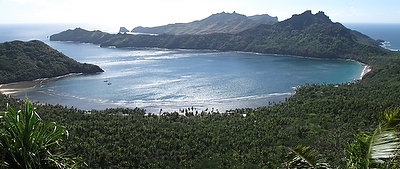
The little picture doesn't begin to do justice to this setting, but maybe it gives you some idea. We're looking east and the island rises 3,000 ft with the top half pretty much constantly shrouded in clouds. Everything is dripping green from the intermittent showers and drizzle. You can just see the small village at the bottom left of the picture below the rock spires.

The real magic is in the late afternoon when the last few hours of sunlight play across the the rocks and vegetation with patches of sun and shadow creating incredibly subtle graduations of green. In this shot you can also see a portion of a rainbow.

Today was rain on and off with the wind spinning all the anchored boat a full 360 degrees several times during the course of the day. But we were mustered some motivation, inflated the dinghy and took the trip ashore. The residents were very friendly and the village totally clean, not a scrap of litter or debris. While we stood under a tree to wait out a period of intense rain we were invited to stand on a woman's porch and then she gave us some bananas to snack on and made small talk in our pathetic French while we waited. A nice introduction to French Polynesia.

Friday, May 13, 2011

Passage summary

A great sleep last night after two bottles of champagne and a culinary tour de force. This is an amazing anchorage. The visual beauty is just stunning. And for entertainment we've had pods of spinner dolphins swimming within 50yds of the boat, leaping out of the water, doing flips or spinning on their tails. Dazzling. Tomorrow we'll get motivated, inflate the dinghy and go ashore. Today we're just lazy on the boat enjoying the quiet.

Here is the summary of our passage from the Galapagos:

Rhumb line (shortest) distance: 2,908 nautical miles
- 3,344 statute miles = SF to NY to Chicago

Distance sailed: 3,098nm
- 3,562 statute miles = SF to NY to St Louis = Paris to Kabul

Duration: 16 days 7 hours (16.3 days)
Miles / day: 190
Best day: 210 miles
Worst day: 171 miles
200 miles days: 4 (plus one day of 199 miles)

Average speed: 7.92kts
Motoring time @ 7.2 kts: 31hrs
Reefs put / taken out: too many to count!

Oatmeal cherry chocolate chip cookies eaten: 36
Beers consumed: 3 (under performed…)
Hours slept: too few
Scrabble: Fay 4 games - Russ 2 games

Thursday, May 12, 2011

Anchored in Hanavave

The passage was 3,095 miles, 16 days. Nobody hurt and no major equipment problems.

The anchorage is crowded, our anchor is in 100' and the view is stunning. Google Bay of Virgins, Fatu Hiva for a look. It was the Bay of Penis' until the French priests got here. You'll see the namesake rock formations on the left side of any picture of the bay.

Time for some champagne and sleep.

Land Ho!

Fay has spotted Fatu Hiva on the port bow!

Motoring to the finish

With great reluctance we turned the motor on about midnight. The wind had backed all the way to the east, actually a little north of east, and dropped to about 12kts. We don't fly the spinnaker at night, and without it we could not make more than 5-6kts towards our destination (either gybing down the wind or sailing dead downwind). We could sail to the finish, but we would have to add another day to our trip.

Essentially we have about an 8-10hr arrival window each day. We don't arrive at night, so that eliminates 12 hrs of each day, and we can't plan to arrive too late in the afternoon since any small problem could push us into darkness. Had we continued sailing we would probably have arrived about 5-6pm, too late in the afternoon.

Even motoring we are plagued by the cross seas. We're motoring straight downwind which would normally put the seas behind us. Instead we have seas behind us, but also on our port quarter or beam so we still get rolled around. The sun will rise soon and we'll use our motoring time and power to make water and give New Morning a fresh water wash down. With the salt washed off the deck and lifelines we'll also be able to wash clothes and hang them out to dry.

It's been a long passage (3,000 miles and 16 days). We're tired and a bit cranky. But we also have a nice bottle of champagne in the refrigerator. If everything holds together for about 12 hours we should be drinking that champagne by late Thursday afternoon!